
The tear resistance test of paper plays a critical role in evaluating how paper materials perform when subjected to sudden tearing forces. In packaging, printing, labeling, and industrial paper applications, tear resistance often determines whether a product can withstand handling, converting, and end-use stresses. Unlike tensile or burst strength, tear resistance reflects a paper’s ability to arrest crack propagation once tearing has already begun, making it a key indicator of durability and reliability.
Understanding Paper Tear Resistance in Material Performance
Tear resistance describes the force required to continue a tear through paper after initiation. Fiber length, bonding strength, basis weight, refining degree, and sheet formation all influence this property. Papers with long fibers and flexible structures often show higher tear resistance, even when their tensile strength appears moderate.
In many applications—such as corrugated liners, sack paper, labels, and technical papers—tear resistance complements tensile and burst tests, offering a more complete picture of paper strength behavior.
ASTM D689, Paper Strength Tester, and Elmendorf Tearing Test
ASTM D689 and Its Industry Role
ASTM D689 defines a standardized approach to measuring the tearing resistance of paper using an Elmendorf-type apparatus. The method focuses on tearing force perpendicular to the plane of the paper, ensuring repeatable and comparable results across laboratories.
By following ASTM D689, manufacturers and testing labs establish consistent benchmarks for internal tearing resistance in both the machine direction (MD) and cross direction (CD).
Elmendorf Tearing Test Principle
The Elmendorf tearing test uses a pendulum system to tear one or more paper plies through a fixed distance. As the pendulum swings, part of its potential energy is consumed in propagating the tear. The instrument converts this energy loss into a tearing force value.
This approach allows the tear resistance test of paper to reflect the average force required during tearing, not just the peak force at crack initiation.
Role of a Paper Strength Tester
A calibrated paper strength tester equipped for Elmendorf tearing ensures accuracy and compliance with ASTM D689. Modern instruments provide stable pendulum motion, precise clamping, and clear digital or analog readings, supporting reliable quality decisions.
Step-by-Step Tear Resistance Test Procedure
- Clamp the paper specimen securely in the tearing tester grips.
- Introduce a controlled pre-cut or slit to define the tear start point.
- Release the pendulum to propagate the tear over a fixed distance.
- Record the tearing force displayed by the instrument.
- Repeat the test multiple times in both MD and CD to ensure statistical validity.
By averaging accepted readings, the tear resistance test of paper delivers representative values suitable for quality control and material comparison.
Why Tear Resistance Matters in Paper Applications
The tear resistance test of paper helps predict how paper behaves during:
- Bag filling and handling
- High-speed converting operations
- Packaging transportation and storage
Higher tear resistance often improves product reliability, while excessively high values may indicate stiffness or poor runnability. Balancing tear resistance with tensile, burst, and stiffness properties remains essential.
Instrument Selection and Testing Efficiency
For laboratories seeking dependable results, the Cell Instruments SLD-01 Tear Tester offers a practical solution for Elmendorf tearing tests. Designed to align with ASTM D689 requirements, it supports stable pendulum operation, flexible ply configurations, and repeatable measurements—making it suitable for routine QC and R&D environments.
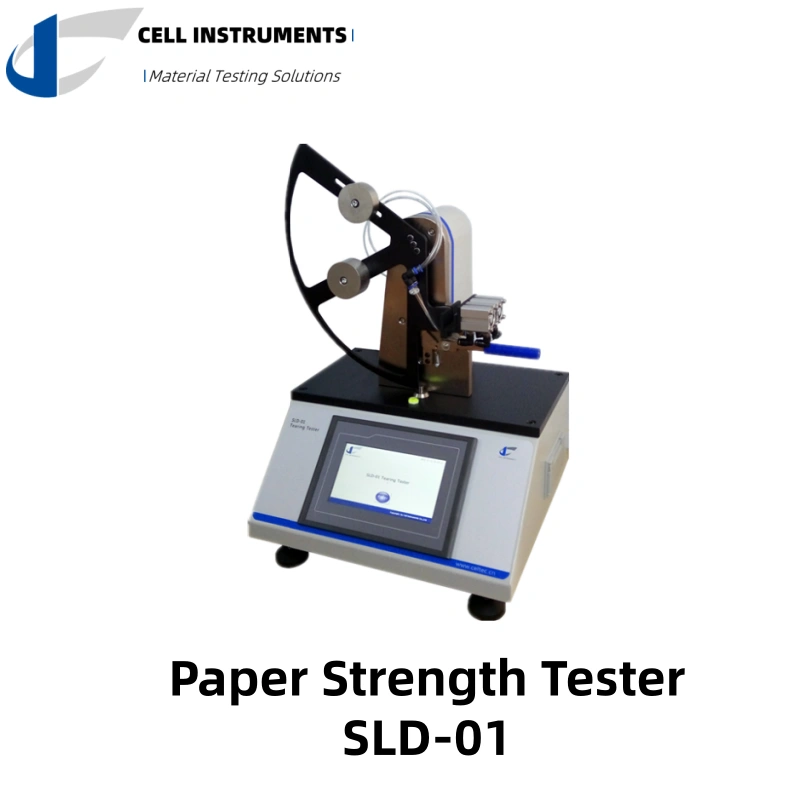
Rather than focusing on equipment features alone, effective testing relies on correct method execution, proper conditioning, and consistent reporting, all of which the SLD-01 supports in daily use.
Conclusion
The tear resistance test of paper provides critical insight into paper durability and end-use performance. By applying ASTM D689 and the Elmendorf tearing test method, manufacturers and quality professionals gain reliable data to optimize materials, reduce failures, and maintain consistent product quality.
When combined with a capable paper strength tester and disciplined testing practices, tear resistance measurement becomes a powerful tool for paper evaluation across packaging, printing, and industrial applications.
 EN
EN  AR
AR  BG
BG  CS
CS  DA
DA  DE
DE  EL
EL  ES
ES  ET
ET  FI
FI  FR
FR  HU
HU  ID
ID  IT
IT  JA
JA  KO
KO  LT
LT  LV
LV  NB
NB  NL
NL  PL
PL  PT
PT  RO
RO  RU
RU  SK
SK  SL
SL  SV
SV  TR
TR  UK
UK